





 Trap
 Continuous
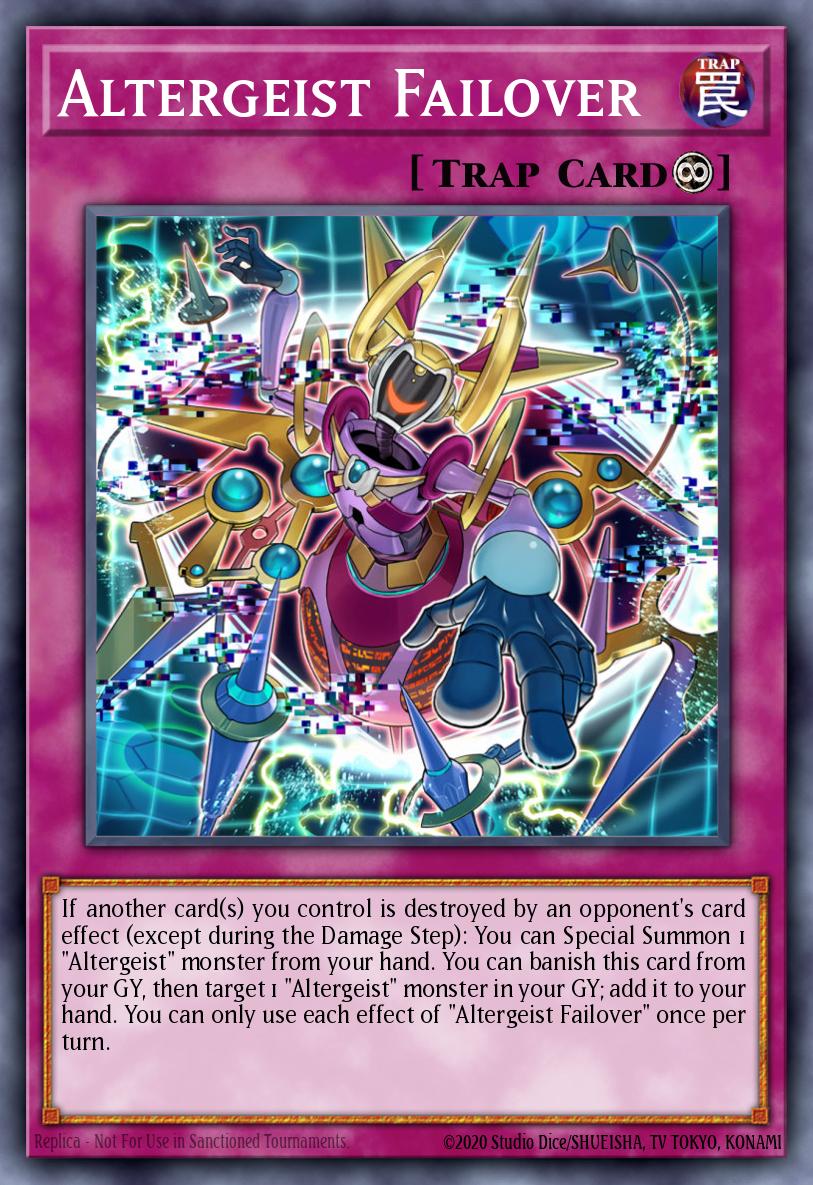
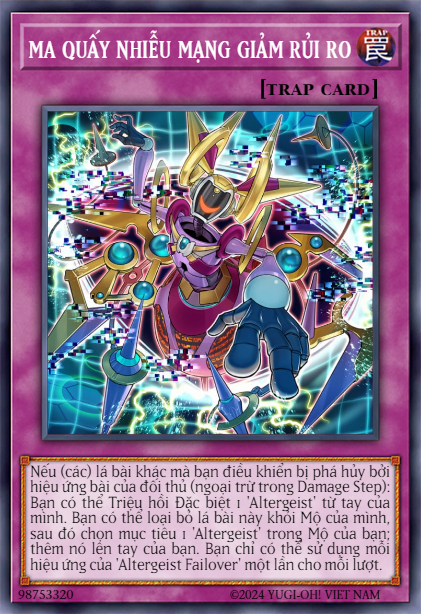
Altergeist Failover
Archetype:
Altergeist
View:
2896
If another card(s) you control is destroyed by an opponent's card effect (except during the Damage Step): You can Special Summon 1 "Altergeist" monster from your hand. You can banish this card from your GY, then target 1 "Altergeist" monster in your GY; add it to your hand. You can only use each effect of "Altergeist Failover" once per turn.
Altergeist Failover — Power Evaluation
Final Score: 49 ± 8 · Confidence: Medium
- Intrinsic: 49 · Deck: 49 · Meta: provisional
- Primary role: Recovery/Recursion · Secondary: Utility
Why it scores here
Altergeist Failover is a set trap whose value is recursion: it can Special Summon an Altergeist monster from hand after one of your other cards is destroyed by an opponent's card effect, and it can banish itself from the GY to add an Altergeist monster from the GY to hand. It converts destruction events into a body and a recovered card, but it needs its trigger to happen and the text is archetype-locked. The card's high deck count (in 20 of 20 sampled decks, with 2.3 copies on average) confirms it is a reliable Altergeist staple, not that it is powerful on its own; the score is held down by the absence of combo evidence and by the lack of any direct negation or removal.
Axis scores
| Axis | Score | Evidence |
|---|---|---|
| Accessibility | 55 | Runs in 20 of 20 sampled decks at an average of 2.3 copies, but it is a set trap whose main effect needs a trigger and its GY effect is restricted to Altergeist targets (observed deck data; no combo starter stats). |
| Combo & Conversion | 40 | No recorded combo boards contain the card, so conversion is text-only: a conditional body summon after an opponent-effect destruction (inferred). |
| Resource Economy | 60 | GY banish to add an Altergeist monster is a roughly even card swap that recovers a card from the GY; no net advantage is shown (verified card text, inferred value). |
| Effect & Interaction | 25 | No negation, removal or hand-trap reach; it only punishes or responds to destruction after the fact (verified card text). |
| Material Utility | 25 | The card itself is a trap and is not material. The summoned Altergeist body is the only material output, which is archetype-dependent (inferred). |
| Resilience & Flexibility | 50 | Usable from the field and the GY, so it can act across two zones and multiple turns, but the trigger depends on an opponent destruction event (verified card text, inferred). |
| Deck-Building Efficiency | 60 | One non-garnet trap with multiple copies accepted, but it is locked to the Altergeist archetype and adds nothing outside it (observed deck data and text). |
Calculation
Weight profile: Primary role Recovery/Recursion only, no secondary blend. Intrinsic ≈ 49, Deck ≈ 49, Meta = provisional. Modifiers: archetype-locked support (-2). Final formula: 0.40*Intrinsic + 0.60*Deck
Strengths
- Converts an opponent destruction event into a body from hand
- GY banish lets it recover an Altergeist monster, giving it a second use
- Near-universal inclusion in the sampled Altergeist decks, so the route is live
Weaknesses
- Needs an opponent card effect to destroy one of your other cards before it does anything
- Only works for Altergeist monsters, so it has no value outside the archetype
- The GY effect is a 1-for-1 recovery, not a card advantage engine
Counters / choke points
- Opponent cards that avoid destruction or prevent card effects from destroying your cards
- Hand traps and negation that stop the destruction event before the trigger resolves
Best use
Recovery/Recursion body and recovered Altergeist support. Decks: Altergeist. Suggested copies: 3.
Evidence & gaps
- Verified: Card text: summons an Altergeist from hand after an opponent effect destroys another of your cards (not in the Damage Step); Card text: banish from GY to add an Altergeist monster from GY to hand; Card text: each effect is once per turn
- Observed: Appears in 20 of 20 sampled decks at 2.3 copies on average, 19 of them Altergeist; Partner co-occurrence with Altergeist core cards is 75% to 100%
- Inferred: Recovery/Recursion is the primary role because its value is a body plus a recovered card rather than disruption; The GY effect is a 1-for-1 recovery with no net advantage
- Data gaps: No combo boards recorded, so combo conversion rests on text alone No banlist token supplied; assumed 3 copies No StatisticsCard usage statistics Guide evidence is a single section with no substantive card analysis